Hendersonville, NC · Garage Door Service
Torsion spring repair for Etowah's late-1980s two-car doors, built by a crew that drives the eight miles out from Hendersonville and knows what that era's hardware looks like.
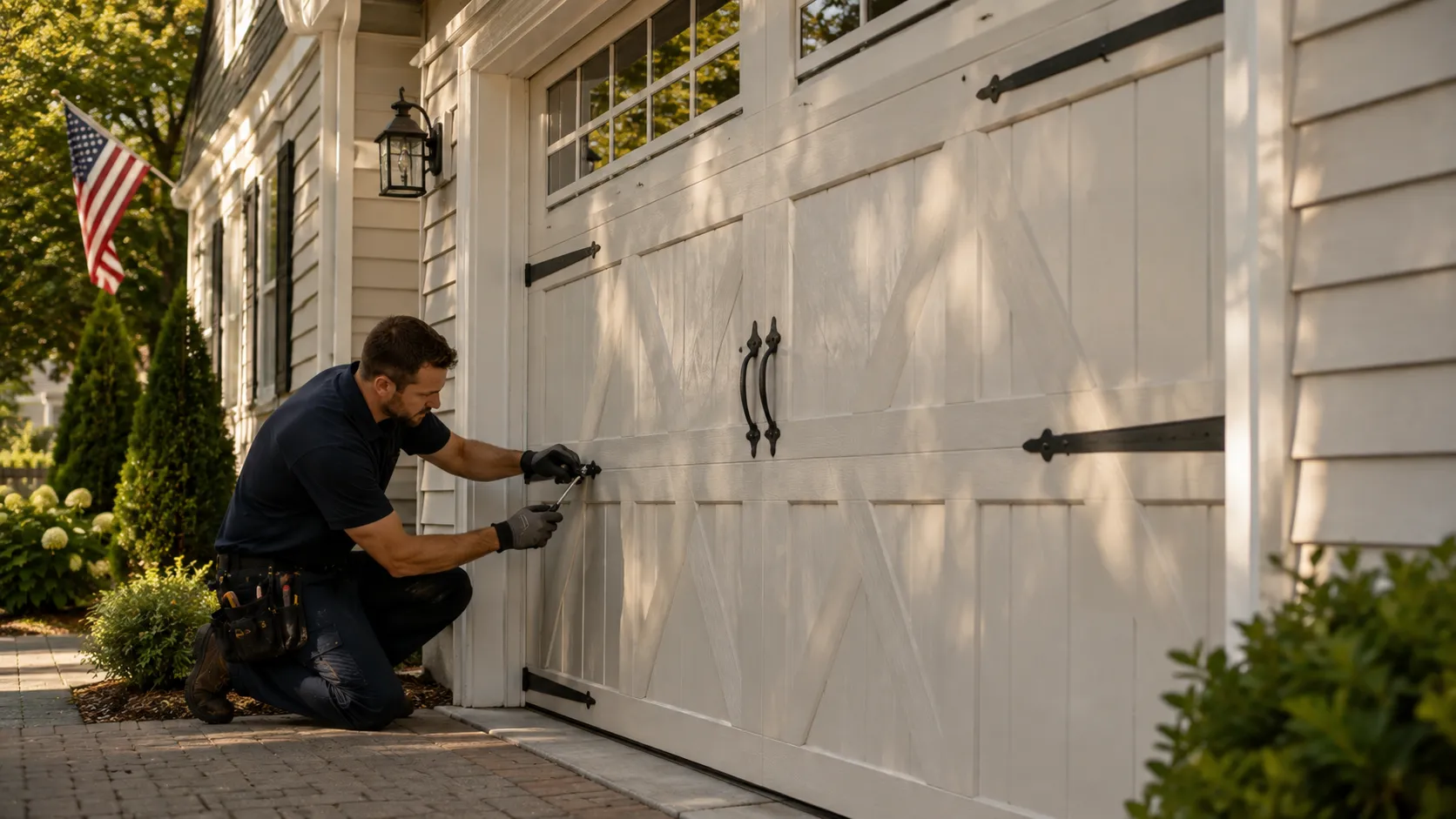
Most of the garage doors standing in Etowah went up around 1988, which puts them right in the stretch when steel two-car doors on torsion springs became the default over the old single-panel, extension-spring setups. That matters before you ever get to what's broken, because a torsion spring on a door this size is wound under real tension - enough to break a wrist or worse if you unwind it with the wrong bar or no bar at all. If your door has one spring mounted above the center of the opening on a shaft, that's torsion, and it's not a job to learn on your own garage. Extension springs, the kind that stretch along the horizontal tracks, are a little more forgiving to look at but still store enough energy to hurt you if a cable lets go. You can safely check the obvious things yourself: does the door hang crooked, is there a gap where a coil separated, does the opener strain and reverse. Past that, the honest move is to leave the winding cone and the bars alone. We'd rather get a call for a five-minute look than a call after someone's improvised a fix with a pair of vise grips and a ladder.
We're not going to put a number here that we can't back up for your specific door, because a broken spring on a single 8-foot door and a broken spring on a double-wide 16-footer from the same 1988-era build are not the same repair, and pretending otherwise is how a homeowner ends up quoted one price on the phone and billed another in the driveway. What we can tell you is what drives the number: whether it's one spring or a matched pair (doors this size almost always run two), the wire gauge and wind length the shaft actually needs, and whether the drums, bearings, or cables have worn out alongside the spring - which happens often on hardware that's been cycling for over three decades. We price the job after we've had eyes on the door, not before.
We run out of Hendersonville, and Etowah is an eight-mile drive from there - close enough that it's a straightforward add to the day's route, not a special trip. When you call, tell us what the door's doing: won't open, opens partway and stops, one side hangs lower than the other, or it just came off with a bang. That tells us whether we're loading a torsion spring, an extension pair, or checking for a snapped cable that's just mimicking a spring failure. We ask for the door's rough age and whether it's single or double, since Etowah's stock clustering around the late 1980s tends to run standard torsion setups, and knowing that before the truck leaves saves a second trip for the right part.
For a service area where the housing stock runs mostly 1980s and 90s builds, we stock torsion springs in the wind lengths and wire gauges that fit those original openings, plus the matching drums, bearing plates, and lift cables that tend to give out around the same time as the spring on a door that's been running that long. We carry extension springs too, for the smaller number of older or single-car doors that still use them. What we don't carry is every obscure spring size ever made - if your door's had a nonstandard replacement track or opener retrofit somewhere along the way, that can mean a part gets ordered rather than fitted same-visit. It's not common on doors from this era, but it happens, and we'd rather tell you that up front than promise a fix we can't finish that day.
The winters out this way run cold enough, and hard enough on steel, that a spring already thirty-plus years into its coil life is doing double duty - contracting and expanding through the cold snaps on top of the fatigue from decades of cycling. That's usually when we get the call: a spring that was fine in October lets go in a January cold stretch. The other place this goes sideways is rust. A door that's sat in a damp or unheated garage for that long can have a spring, cable, or bearing plate seized or corroded past a clean fix, and at that point patching one part just shifts the failure to the next weak link a few months out. When we see that, we'll say so rather than sell a single-part repair on a door that needs the whole spring-and-hardware set replaced together.
If the opener motor runs but the door barely moves, or moves and then reverses, that's almost always a spring or cable problem, not the opener - the motor isn't built to lift the door's full weight on its own. A door that won't respond to the remote or wall button at all points more toward the opener itself.
Given that most of the area's homes went up around 1988, the majority run torsion springs mounted on a shaft above the opening, which was the standard setup for two-car steel doors by that point. Older single-car doors in the area are more likely to still have extension springs along the tracks.
It can happen, but springs installed as a matched pair usually wear at a similar rate since they've cycled the same number of times under the same load. We'll check both sides even if only one has visibly failed, because replacing just the broken one often means the older survivor fails again within months.
Call now or request a free quote - same-day service on most repairs, upfront written pricing.