Hendersonville, NC · Garage Door Service
Garage door opener repair for Hendersonville, NC homes built 1959-2001, where cold winters strain aging chain-drive openers and worn gears fast today.
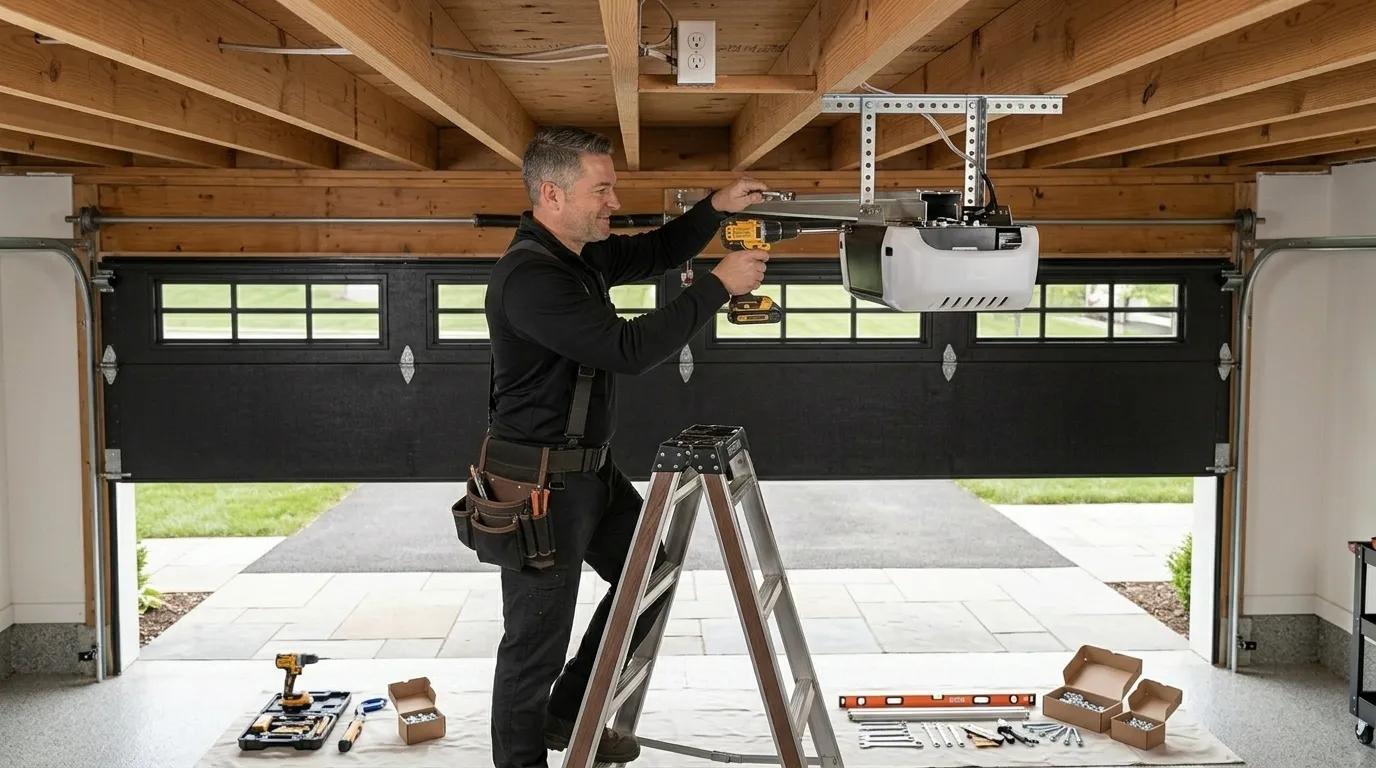
There's a fair bit you can safely check before calling anyone. Wipe down and lubricate the chain or belt with a light garage-door grease, not household oil, which gums up in cold weather. Check that the photo-eye sensors near the floor are aligned and free of dust or spider webs - a knocked-out-of-line sensor is one of the most common reasons a door reverses for no reason. Reprogramming a remote or keypad is usually a five-minute job you can do from the owner's manual or the buttons on the motor unit itself. Adjusting the travel limits (how far up or down the door goes before the motor stops) is also within reach for most owners, with the dial or screw usually on the back of the unit.
What we don't recommend doing yourself: opening the motor housing to get at the internal gear or capacitor, or touching anything connected to the torsion springs above the door. The gear inside an opener from this era is usually molded nylon, and once it's stripped it has to be replaced as a unit - cracking the housing on a unit that's still under some life expectancy isn't worth the risk to your hands or the door.
A straightforward opener repair - a bad sensor, a stripped gear, a burnt-out logic board - is usually a single visit once we've seen the unit and confirmed what's actually broken over the phone or in photos first isn't reliable, because openers fail in ways that look identical from the outside but aren't. Grinding can mean a gear, a worn sprocket, or a motor bearing, and those aren't the same repair.
Where it takes longer is when the opener itself is old enough that the manufacturer has stopped making parts for it. That happens more often here than you'd think, given how much of the housing stock still has its original chain-drive unit from the 1980s or 90s. In that case the honest answer is that repair isn't always the right call - past a certain point, replacing the opener costs about the same as sourcing a discontinued gear kit and you get a warranty on the whole unit instead of one part.
Most homes in the service area went up between 1959 and 2001, with the median build year landing around 1982 - which is exactly when chain-drive openers with molded nylon drive gears became standard equipment. That gear is the single most common failure point we see, because nylon gets brittle with age and with cold.
Hendersonville's winters sit in the severe end of the cold climate band, and that cold is hard on the grease and plastic gears inside a 1980s-era opener. Grease that's fine in a heated space thickens in an unheated attached garage, which puts extra load on a motor and gear that were never rated for that kind of drag to begin with. Across the 20 communities in this service area, from three-mile-out neighborhoods to towns twenty miles out, the same 1980s and 90s stock repeats itself, so this isn't a one-house problem - it's a housing-stock problem. With roughly 21,469 owner-occupied houses across the area, a large share of them are still running the original opener that came with the house, well past the point most manufacturers expect that gear to last.
If your opener hums but the door doesn't move, that's usually a stripped gear - the motor is running but not turning anything. If the door starts down and reverses back up before it touches the floor, look first at the sensors, then at the down-limit setting. A remote that only works from a few feet away, when it used to work from the driveway, points to a weak antenna connection inside the unit or a dying circuit board rather than the remote itself.
A grinding or clicking noise partway through the open or close cycle is worth taking seriously before it turns into a full stop - it's the sound of a gear tooth breaking off a few at a time. And if the wall control light blinks in a pattern rather than staying steady, that's the unit's own error code; the number of blinks usually maps to a specific fault in the manufacturer's manual, and it's worth checking before assuming the whole opener is dead. The median household income here, at $72,989, is enough for most owners to choose a repair over a full opener replacement when the motor itself is still good.
You can open the cover and look, but if the motor is running and nothing's turning, it's almost always a stripped internal gear - that's a part swap inside the housing, not a lubrication or adjustment fix. It's fine to confirm the diagnosis yourself before calling; just don't try to force the gear or door by hand while the motor is powered.
Hendersonville sits in a severe cold climate band, and the grease inside an opener's gearbox thickens in cold, unheated garages. That extra drag is hard on nylon gears that are already decades old in a lot of the area's housing stock, which is why winter tends to bring more opener calls than repair calls for the door itself.
Depends on what's broken. A sensor or logic board is usually a fair repair. A stripped gear on a unit whose manufacturer no longer stocks parts often costs close to the same as a new opener, and you get a full warranty instead of a warranty on one part - at that point replacement is the better call.
By Neighborhood
We also handle opener repair in these Hendersonville-area suburbs.
Call now or request a free quote - same-day service on most repairs, upfront written pricing.