Hendersonville, NC · Garage Door Service
Mills River homes mostly went up around 1997 - newer steel doors, standard panel sizes. Hendersonville Garage Door Pros drives 8 miles out for panel swaps.
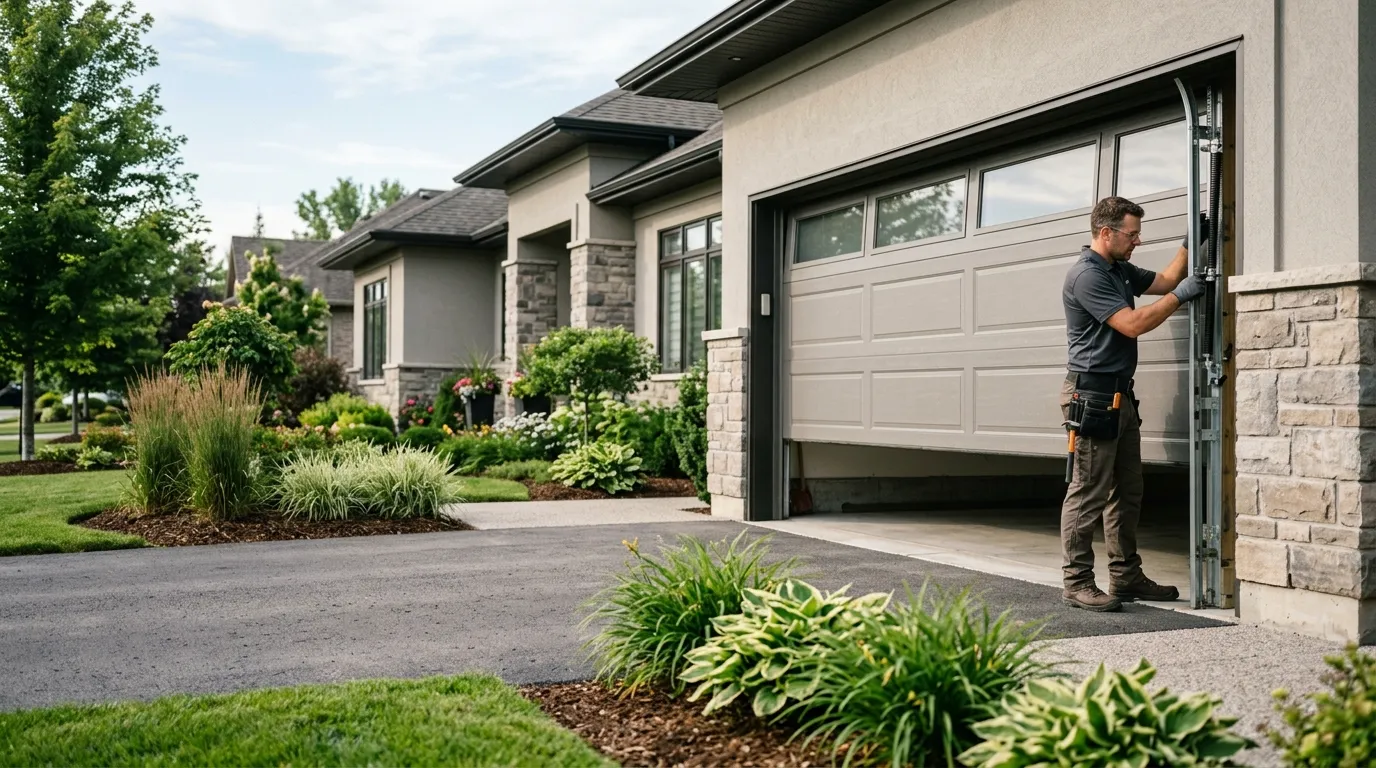
Most houses out in Mills River went up around 1997, which puts this pocket of the service area a good fifteen years newer than the 1982 median you'll find across the rest of the territory we cover. That gap matters more than it sounds. A door built in the late '90s is almost always a steel raised-panel unit on standard 90-inch or 96-inch sections, hung on torsion springs sized to a common weight range - not the older flat or fiberglass panels you'd find on a house from the '60s or '70s.
What you're usually seeing when a panel fails here is a dent or a crack from an impact - a trailer backing wrong, a basketball, a bumper tap - rather than the rot or delamination that shows up on older wood-composite doors. The steel itself holds up fine for decades unless something hits it. When it does get hit, the panel deforms in a way that's hard to pull back true, and the track alignment goes with it if the hit was low enough. On a newer door like this, replacing the section is usually straightforward because the panel style is still common. That's the good news the age of this housing stock gives you.
Cold-climate swings hit steel panels differently depending on how they're built, and the region here rates as a severe cold-weather zone. On a late-'90s door, panels are usually insulated with a foam core between two steel skins. When one section takes a hit hard enough to crack the outer skin, moisture gets into that foam over a winter and the panel starts to feel heavier, sometimes visibly bows. You won't always see it from the driveway - it shows up as the door running rough on the track or the opener straining on that one section.
With 2,818 households out this way, it's a smaller service pocket than the rest of the territory, and the median income here runs noticeably higher than the wider county figure of $72,989. That combination tends to mean owners replace a damaged panel outright rather than living with a dent, which is the right call structurally too - a compromised insulated panel keeps a garage colder and puts uneven load on the rest of the door long after the dent itself stopped being cosmetic.
I don't have a fixed number to give you here - panel cost depends on the brand, the exact section height, and whether the color and window layout on your door are still in production, which varies door to door even among houses built the same year. What I can tell you is that on a door this age, matching a single panel is usually possible because the sizing is standard, and that keeps the job to a section swap instead of a full door replacement. If the run has been discontinued or the color has faded enough that a new panel would stand out, replacing the whole door ends up the more honest recommendation, and I'll tell you that on the spot rather than sell you a mismatch.
For a panel job out in Mills River, the truck carries the steel panel sections that fit late-1990s door styles most often, along with the end hinges, roller brackets, and strut reinforcement that come loose or bent when a section takes an impact. Torsion spring adjustment tools ride along too, since a dented panel almost always throws the track alignment off enough to need a check, even if the spring itself is fine.
We're driving out from Hendersonville for this one - it's about 8 miles - so the panel that goes on the truck is picked based on what you tell me about the door on the phone: brand, color, window cutout if any. If it turns out to be a style we don't stock a match for, that's a second trip, and I'd rather say that now than promise a same-visit fix I can't back up.
Usually, yes. Most doors out this way were installed around 1997 with standard steel panel sizing, so a single damaged section can often be matched without replacing the whole door. The exception is if the color has faded or the run is discontinued - then a new panel would stand out and full replacement makes more sense.
Late-1990s steel doors usually have an insulated foam core. Once the outer skin cracks, cold-season moisture can get into that foam and add weight or cause a slight bow. It's more common on doors that took a hit and sat a season or two before the repair.
It depends on the door. We drive out from Hendersonville, about 8 miles, and load the panel based on what you tell us about the brand and style beforehand. If it's a common late-'90s steel style, we usually have a good shot at a same-visit match.
Call now or request a free quote - same-day service on most repairs, upfront written pricing.