Hendersonville, NC · Garage Door Service
Torsion spring repair for Mountain Home, NC homes built around 1979. We travel the four miles from Hendersonville for broken springs on original hardware.
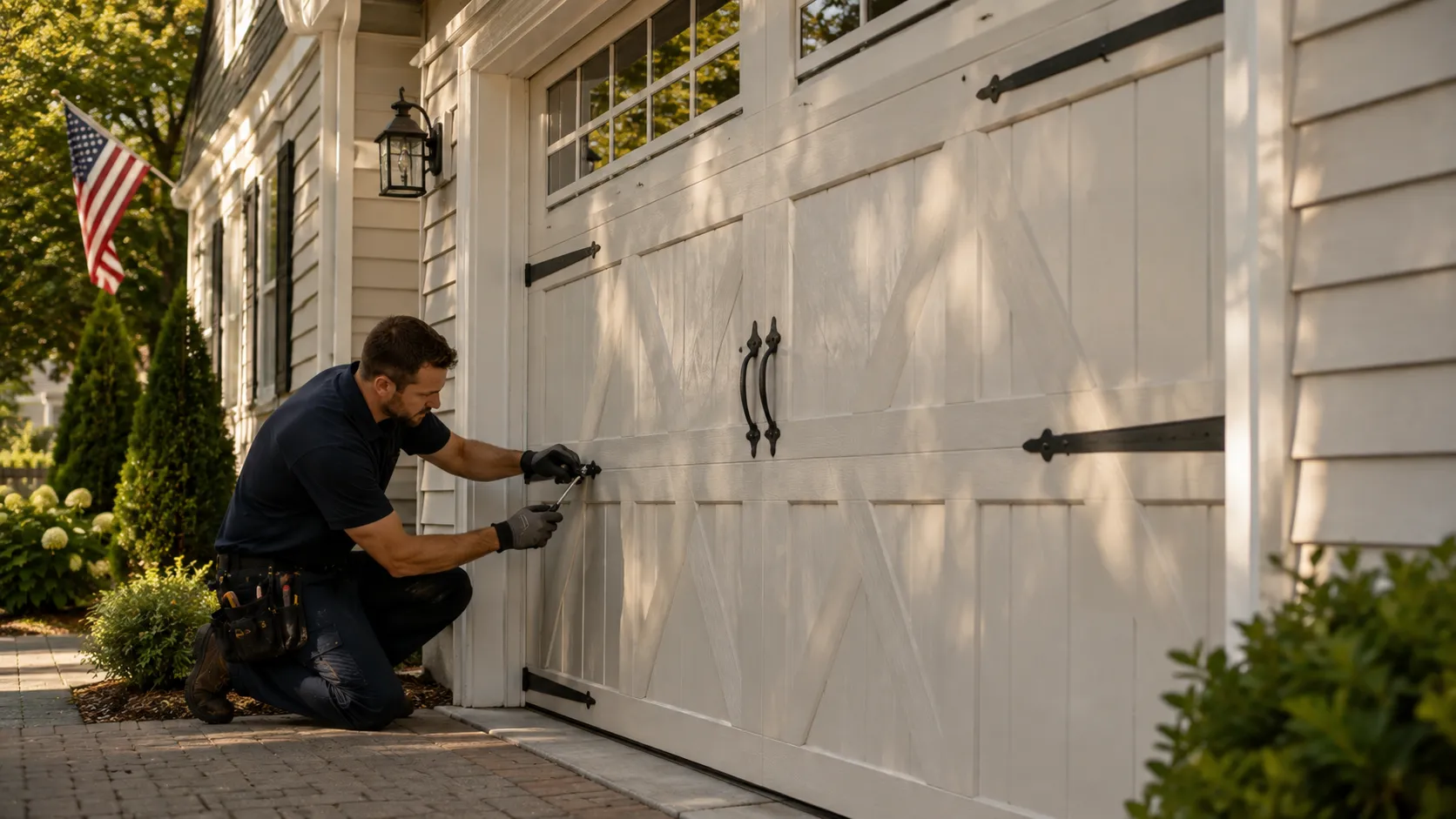
A torsion spring under load can put someone in the hospital, and that risk doesn't change because the door is thirty or forty years old. What does change in a place like Mountain Home is the hardware you're working with. Most houses here went up around 1979, which puts them squarely in the era when builders had moved to torsion springs but hadn't yet standardized on the coil sizes and drum styles that got common in the 90s. That means the spring on your shaft may not match what's on the shelf at a big box store, even if the winding looks familiar.
If you're the kind of owner who changes their own oil, you can inspect: look for a gap in the coil, listen for a bang from the garage before the door goes limp, check whether the door feels twice as heavy when you lift it by hand with the opener disconnected. That's as far as we'd recommend going without the right winding bars and a clamp. Cutting a wound spring loose with the wrong tool is the single most common way this job sends someone to urgent care, and we've replaced more than one door that took damage from an owner's first attempt.
We don't have a published price list to quote you here, and giving you a number without seeing the door and spring size would be a guess dressed up as a fact. What we can tell you is what drives the cost up or down on a Mountain Home call: whether it's one spring or a matched pair, whether the drums and bearings are original from a 1979-era build and need replacing alongside the spring, and whether the cable has started to fray from riding on a worn drum. A single spring on a light door is a different job than a matched pair on a heavy insulated double, and a house from this build era is more likely to still have the lighter original door than a newer replacement.
The honest limitation: if your opener, track, and hinges are all original to a house built in 1979, replacing just the spring sometimes just moves the next failure to the next weakest part. We'll tell you straight if that's what we're looking at rather than sell you a spring and let the drum take you out next winter.
A door that won't budge, or drops the last foot on its own, almost always means one thing: the torsion spring has let go, either snapped clean or slipped its winding cone. On a house built around Mountain Home's median year of 1979, that spring has had over four decades of winters to fatigue. Cold-climate steel doesn't fail because it's cold on the day it breaks - it fails because repeated contraction in hard winters and expansion in summer heat works the temper out of the coil a little more every season.
Sometimes what looks like a spring problem is actually a broken cable or a bent track from years of a heavy door leaning on worn rollers. If the door came down hard and fast rather than just refusing to lift, check the cable on both sides before you assume it's only the spring. We see both on the same call often enough in this area that we always check the whole system, not just the part that announced itself.
The failure we see most in Mountain Home isn't a bad spring install - it's replacing the spring and stopping there. On a door this old, the drums, bearing plates, and center bracket have usually never been touched. A new spring on a worn drum wears the new cable at the same rate the old one wore out, and you're back to a dead lift in a season or two.
The other way it goes sideways is size. Spring wire diameter, coil length, and wind direction all have to match the door's weight and the drum it turns, and a mismatch either leaves the door too heavy for the opener or, worse, over-tensions and snaps again within weeks. With roughly 1,542 households in Mountain Home and a housing stock that's fairly uniform for its age, we see the same handful of spring sizes repeat job after job - which helps us get it right the first time, but it's still a measurement, not a guess.
For a spring call in Mountain Home we carry torsion springs across the range of wire sizes and wind lengths common to doors from the late 1970s through the 1990s, along with the winding bars, vise grips, and a step ladder rated for the work - not the tools an owner is likely to have sitting in the garage. We also carry replacement cables, bearing plates, and center brackets, since on a door this age those parts are often as tired as the spring itself and worth swapping while the door is already unloaded.
What we don't carry is a stock of custom or oversized commercial springs - those get ordered once we've measured your door, which can add a day or two if your door turns out to need something outside the common residential range. That's the one lead-time limitation worth knowing about before you book: most Mountain Home jobs finish in one visit, but a nonstandard size occasionally means a second trip.
Torsion springs don't usually give a warning; they fail after thousands of open-close cycles wear down the steel's temper. On a house from the late 1970s, that spring has likely done decades of cycles through cold winters and hot summers, and it simply reaches the end of its fatigue life.
You can, but we don't recommend it. Springs age together, and a new spring paired with an old one puts uneven tension on the door, which shortens the new spring's life and stresses the opener. Most jobs with double springs get replaced as a matched pair.
We travel the roughly four miles from Hendersonville to Mountain Home for spring calls; we don't have a fixed response time to quote you, but proximity means it's a straightforward trip once we know the spring size your door needs.
Not usually, if the opener has been running fine otherwise. A broken spring makes the opener strain to lift a door it wasn't built to lift alone, and repeated strain can wear the gears, but that's a separate check we make while we're already at the door.
Call now or request a free quote - same-day service on most repairs, upfront written pricing.