Hendersonville, NC · Garage Door Service
Hendersonville Garage Door Pros install doors built for this area's 1959-2001 housing stock and cold-severe winters, from Balfour to Etowah and beyond.
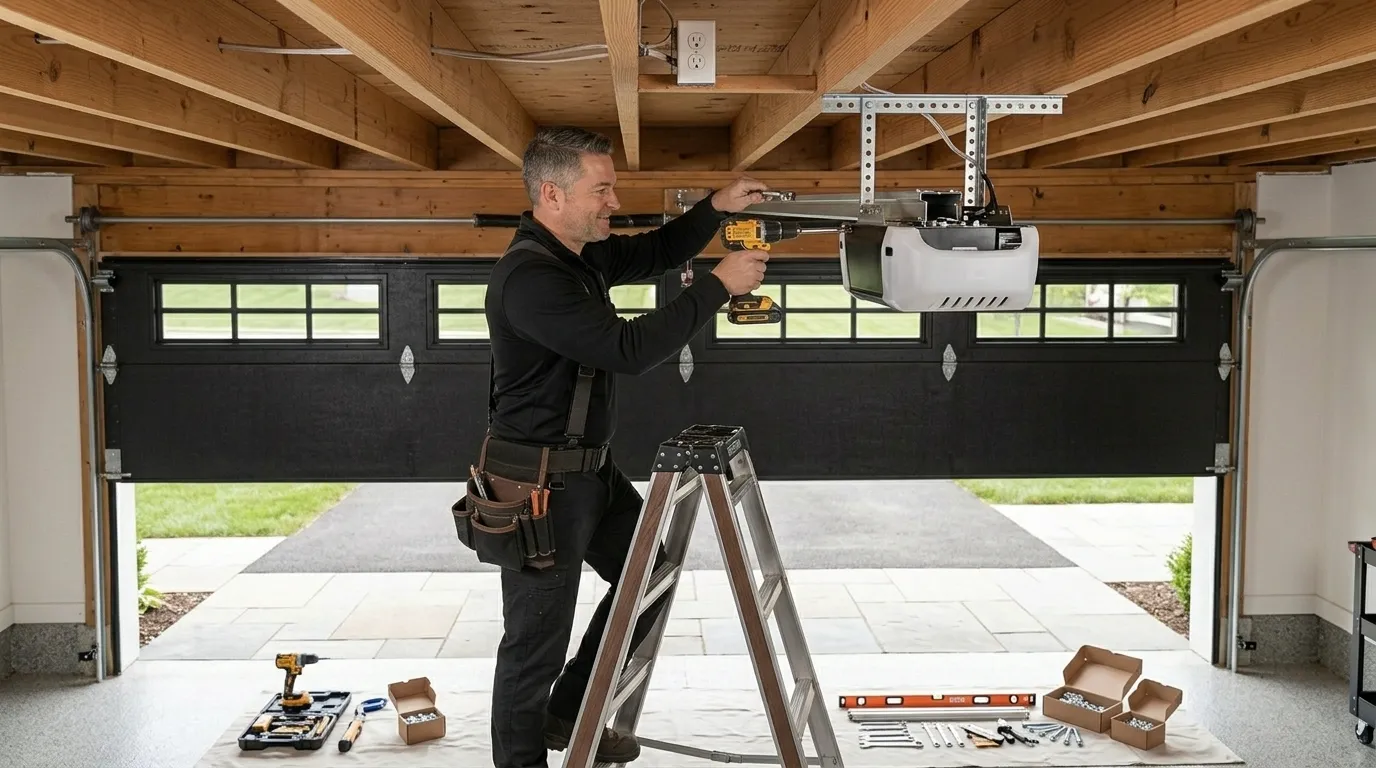
A garage door install looks like a weekend project until you're standing under a 150-pound section with a torsion spring wound to a few hundred pounds of stored force. That spring is what kills DIY installs faster than anything else - it's not a bolt-it-together job, it's a job where the wrong wind on the winding bar puts you in the ER.
There's a second problem specific to this area. Housing here mostly went up between 1959 and 2001, with the bulk in the 1980s and 90s. If you're replacing an original door, your opening was framed to specs and rough dimensions that don't always match what big-box stores sell off the shelf today. A door that's an inch off on width or height gets forced into a track that was never square to begin with, and now you've got binding, not a smooth roll.
We're not going to tell you every homeowner needs a pro for this. If you're swapping a modern steel door for the same modern steel door on hardware installed in the last ten years, a careful DIYer with the right clamps can manage it. What we won't recommend is winding your own torsion spring on an opener you inherited with the house. That's the part worth the call.
A straight swap - same size opening, new door, existing track and opener reused - is a same-day job once the door itself is on site. Where the timeline stretches is the parts underneath the door you can't see until the old one comes off: bent track, a jamb that's shifted out of square, or an opener bracket that was never rated for the new door's weight.
On older openings, especially anything framed before the 1990s, we often find the track was shimmed or re-set at some point by a previous owner or a repair crew working around a spring failure rather than replacing the whole assembly. That adds time on install day because you can't hang a new door plumb on a track that isn't.
Lead time on the door itself depends on style and insulation package - a basic steel door is usually quicker to get than an insulated model in a specific color, and in a cold-severe climate like this one, insulation isn't cosmetic, it affects how the door performs in January. We'll give you a real timeline once we've measured the opening and seen what's actually holding the current door up, not before.
Most of the housing across this service area was built between 1959 and 2001, with the heaviest concentration in the 1980s and 90s. That matters for garage doors in a specific way: those decades used lighter-gauge steel and single-layer construction as standard, with insulation as an upgrade most builders skipped. Forty-some years later, those doors are still on the house, and the foam seals and non-insulated panels have been through decades of a cold-severe winter climate - freeze, thaw, freeze again.
That cycle is what actually breaks things here, more than age alone. A steel panel that isn't insulated flexes more in cold weather, and repeated flex around the same hinge points is where cracking starts. Bottom seals dry out and split, letting in the meltwater that then refreezes overnight and can seize a track.
The same pattern shows up whether you're close in around Balfour or Laurel Park, both about 3 miles out, or further toward Etowah and Fletcher at 8 miles - the building stock and the winters are shared across that whole radius, so the failure mode doesn't change much with distance from downtown. What changes is whether anyone's replaced the door since it was built.
If your door is original to a house from the 1980s or 90s, a few signs point toward install rather than repair. A door that's visibly sagging in the middle of a panel, especially on a double-wide, usually means the steel has fatigued past the point where a new spring or roller fixes it. Cracking along the bottom panel near the seal, especially after a cold stretch, is the insulation gap catching up with the door.
If the door is noticeably heavier to lift by hand than it used to be, or the opener strains and stalls partway up, that's often the springs compensating for a door that's absorbed moisture or warped slightly out of flat - a symptom, not the root cause. Rust at the bottom corners where the panel meets the track is common on doors that have sat through enough winters in this climate, and once rust reaches the hinge points, patching it doesn't hold.
We'll be straight with you: not every one of these calls for a full replacement. Sometimes a section swap or new seal buys real years. We'll tell you which one you're looking at before we quote anything.
We work across the service area, including out to places like Etowah, Fletcher, and Mills River, about 8 miles out, and Balfour, Laurel Park, and Valley Hill closer in at around 3 miles. Distance from downtown affects scheduling more than whether we'll take the job.
Not always. Openings framed in that era don't always match today's standard rough dimensions, and older track hardware may not be rated for a heavier insulated door. We measure the actual opening and check the existing jamb before recommending a specific door.
Given the cold-severe winters this area gets, yes, it's worth considering - an insulated door resists the flex and seal cracking that non-insulated steel panels show after enough freeze-thaw cycles. It costs more up front and we'll quote both options so you can compare.
Sagging in the middle of a panel, rust at the bottom corners, or an opener that strains to lift the door usually point to the door itself failing, not a single part. A cracked seal or a bad roller, on the other hand, is often a repair. We'll tell you which one we're looking at on the visit.
Call now or request a free quote - same-day service on most repairs, upfront written pricing.